
Parent Resources
We are a community of learners, children and adults alike.
If you don’t see what you are looking for here, please reach out to our team of educators and childhood development experts at hello@mia-montessori.com
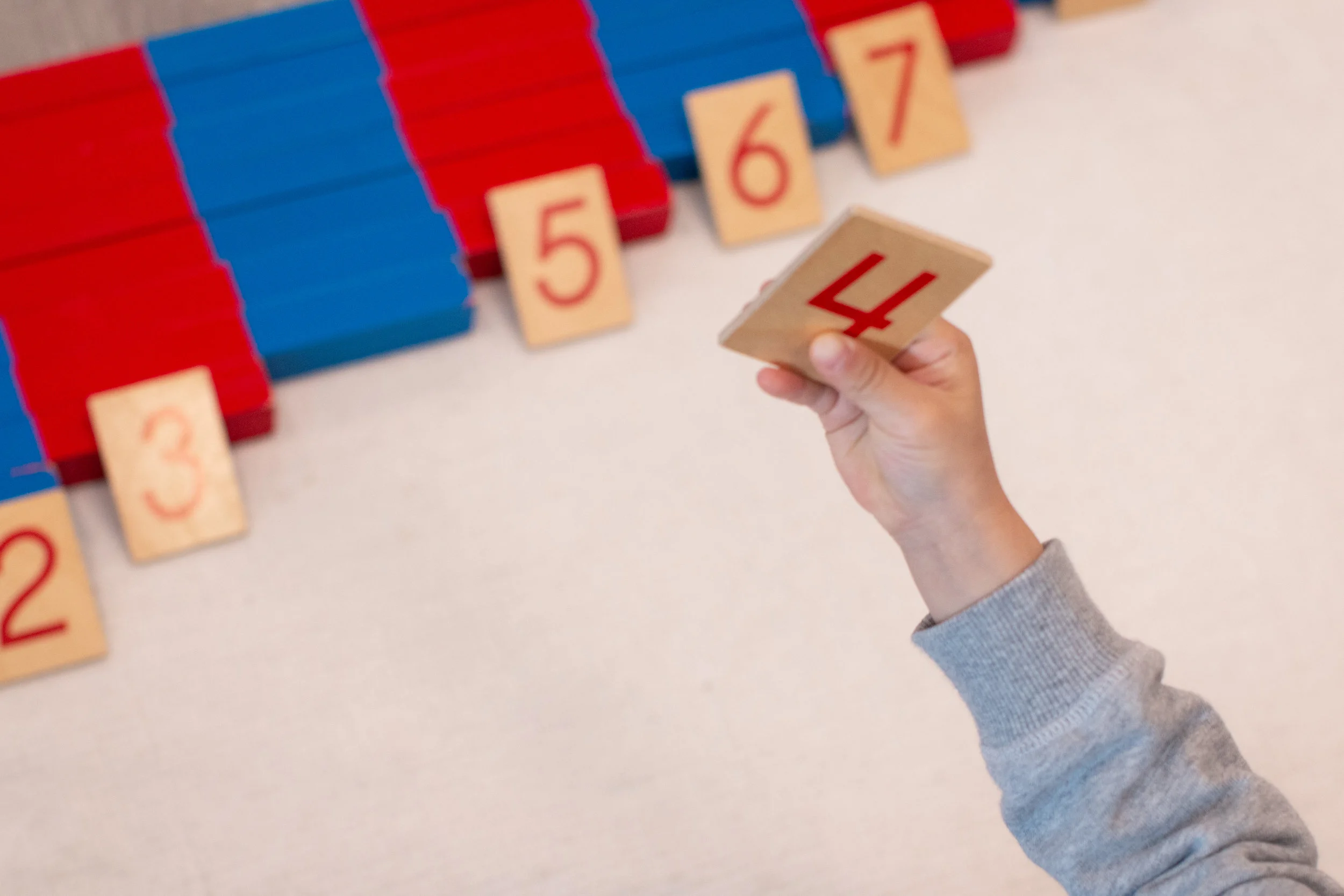
Is Every Montessori School the same? Here’s what parents need to know
Not all Montessori schools are the same - anyone can use it. Here's how to spot an AMI-accredited Montessori school, and why it matters for your child.
If you've started researching Montessori education, you've probably noticed something confusing: almost every preschool and daycare in your search results calls itself "Montessori" in some way. But not all Montessori is created equal — and the differences aren't cosmetic. They affect what your child's day actually looks like, how their teacher is trained, and whether the environment follows Dr. Maria Montessori's method or just borrows the aesthetic.
Here's what parents need to know before choosing a school.
"Montessori" isn't a protected term
This is the part that surprises most parents: in Canada (and most of the world), anyone can call their preschool "Montessori" regardless of training, materials, or philosophy. There's no legal requirement to follow the method, hire certified teachers, or use authentic materials. A daycare can put a few wooden puzzles on a shelf, use the word "Montessori" in its name, and legally call itself a Montessori school.
That's why the label alone tells you almost nothing. What matters is who accredits the school and its teachers.
The three tiers you'll typically encounter
AMI (Association Montessori Internationale) Founded by Maria Montessori herself in 1929, AMI is the original and most rigorous Montessori accrediting body worldwide. AMI teacher training is intensive — typically a full year of graduate-level coursework, supervised practicum hours, and observation-based assessment. AMI schools follow the method closely: uninterrupted work cycles, full sets of authentic Montessori materials, mixed-age classrooms, and teachers trained specifically for the age group they teach (infant, toddler, primary, or elementary).
AMS (American Montessori Society) A well-regarded accrediting body, particularly common in the United States. AMS training is also in-depth, though it allows somewhat more flexibility in classroom implementation than AMI. Many strong schools are AMS-accredited.
"Montessori-inspired" or unaccredited This is the broadest and least regulated category. It can include wonderful programs run by genuinely knowledgeable educators — but it can also include daycares with no Montessori-trained staff at all, using the name because it's popular with parents. Without accreditation, there's no external body verifying teacher training, material authenticity, or fidelity to the method.
What this looks like in a real classroom
The differences show up in the daily experience, not just the paperwork:
Teacher training: An AMI-trained guide (Montessori teachers are called "guides," not teachers) has completed a full diploma course specific to the age group in the room. An untrained staff member, however caring, hasn't studied the observational and material-based methodology that makes Montessori work.
Where that training is actually practiced: Training is only the starting point. AMI's method is built on observation — guides learn to read what a child is ready for and respond in the moment, and that skill sharpens through years of practicing it in an authentic environment. A guide who trained with AMI but has spent years working in a non-accredited setting, without full material sets or a protected work cycle, has had few opportunities to actually use what they learned. That expertise doesn't hold up in storage — it either gets exercised in a genuine Montessori environment or it fades. The credential shows the training happened; the classroom shows whether it's still alive.
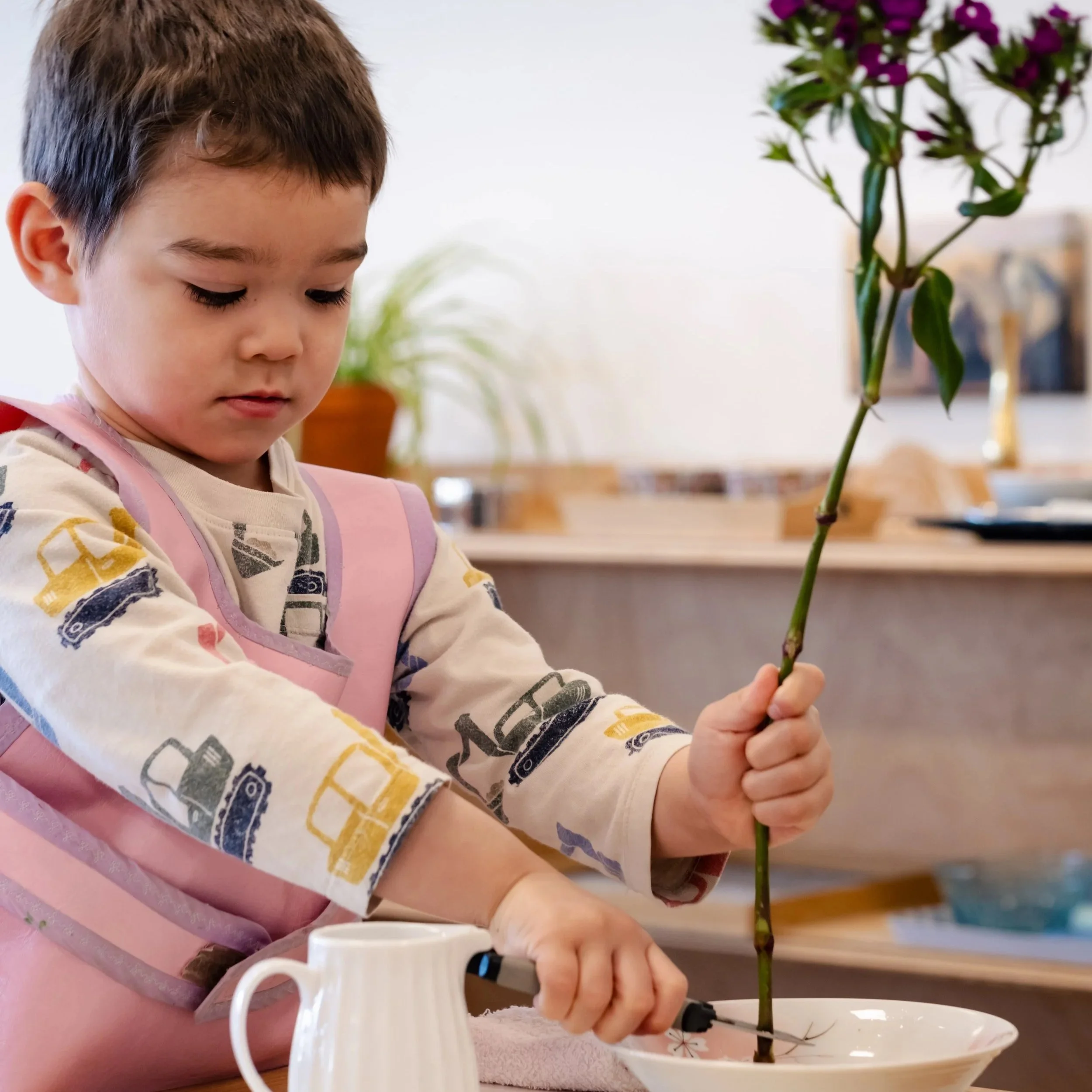
Materials: Authentic Montessori materials are precise, self-correcting, and made from natural materials like wood, glass, and metal — deliberately designed to isolate a single concept and invite repetition. Plastic knockoffs or generic "educational toys" don't offer the same learning function, even if they look similar in a photo.
The work cycle: AMI classrooms protect a three-hour uninterrupted work cycle, which allows children to enter deep concentration — something Montessori identified as essential to development. Programs that break the day into short, teacher-directed activity blocks aren't following this core principle, even if they use some Montessori materials.
Mixed-age classrooms: Authentic Montessori environments group children in three-year age spans (2.5–6, 6–9, 9–12), allowing younger children to learn from older ones and older children to reinforce their knowledge by teaching. Single-age classrooms lose this dynamic.
It starts above the classroom, not just inside it
A credential alone doesn't guarantee this either. AMI training builds an observational skill that's sharpened through years of real practice — a guide who trained with AMI but then worked for years in a setting without full materials or a protected work cycle has had little chance to keep that skill alive. Mia Montessori is the only AMI-accredited Montessori school in western Canada serving children 2.5 to 12 years old.
Leadership matters just as much. When a school's administration and ownership are AMI-trained or committed themselves, that shapes every policy — schedules, hiring, budgets — to protect the method rather than compromise it. It also tends to mean real support for parents applying Montessori principles at home, and a close-knit community of families who share the same philosophy.
For over 30 years, our founder, Meenu Chaudhary, has been a leading voice in Western Canada's Montessori community. She established our school to bring an authentic, AMI-aligned Montessori education to families in the Lower Mainland — a program that, at the time, simply didn't exist here.
That same depth of experience continues through our principal, Ratika Fernandes, who has been a Montessori child since the age of three, having attended a school led by a Head trained directly by Dr. Montessori herself. Ratika is deeply passionate about extending Montessori principles into the home, and is AMI-Accredited to guide families through Montessori at Home for children aged 0–6.
We believe the Montessori philosophy comes fully to life when school and home work in true partnership. That's why parent involvement is woven into every part of our program — through parent-education sessions held throughout the year, open classroom observations, and one-on-one meetings with families. Together, these touch points ensure every child is supported consistently, both in the classroom and at home.
Why this matters for your decision
None of this is to say non-accredited programs can't be good — some are wonderful, run by thoughtful educators who've studied the method independently. But if you're choosing Montessori specifically because you've read about its outcomes — for concentration, independence, intrinsic motivation, or academic depth — those outcomes are tied to fidelity to the method, not just the name on the door.
It's also worth knowing that a credential alone doesn't guarantee this experience. Some guides working in "Montessori-inspired" schools did complete AMI training at some point — but training is a skill that's built through ongoing practice, not a one-time certification. A guide who trained with AMI and then spent years in a setting without full material sets or a genuine work cycle hasn't had the chance to keep developing that observational skill. So the honest question isn't just "is the teacher AMI-trained," but "has the teacher been able to actually practice what they trained in."
Questions worth asking any MOntessori school
-
AMI and AMS schools meet recognized requirements for teacher training, curriculum, and classroom practice. “Montessori-Inspired" or unaccredited schools the teacher training and curriculum would Varies widely — often with no formal Montessori training.
-
A genuine Montessori school will answer clearly and welcome you to see it in person.
Things to look out for include:
Authentic, complete materials sets — in wood, glass, sometimes metal.
An unaccredited school trying to match Montessori materials may use partial sets or plastic substitutes instead.
-
Teachers with AMI or AMS diplomas have completed rigorous, age-specific Montessori training, including a supervised practicum. Ask which age group they are qualified to teach, as Montessori training is specific to each developmental stage.
This also helps you determine whether the school uses authentic mixed-age classrooms (ages 3 - 5 in Primary classes, and ages 6 - 12 in Elementary) or a more conventional single-age model.
-
This can help you understand whether the school offers guidance, resources, and regular communication. Offering resources can help families practice some Montessori principles at home, creating greater consistency and supporting your child's independence and confidence.
See the difference for yourself
Numbers on a page only go so far. We invite all our families to tour our classrooms — we feel it's the best way to understand what authentic AMI Montessori actually looks like.

The Importance of Being Diverse
Diversity, to apply Dr. Montessori’s words, is an “aide to life”. While major media outlets, work environments and society as a whole are talking about the value of diverse perspectives in driving change in our world, what does it mean in an educational setting?
To use the buzzword of the decade - there are many benefits to being in a diverse environment. The political and socioeconomic challenges of our world today could, in many ways be addressed by an understanding and respect for diversity.
What are we saying when we speak about diversity? Many immediately think of race and ethnicity. Diversity is broader than this and includes gender, religion, economic background and even learning styles.
While every major media outlet, work environment and society as a whole is talking about the value of diverse perspectives in driving change in our world, what does it mean to apply it to an educational setting?
Diversity in the classroom

Diversity, to apply Dr. Montessori’s words, is an “aide to life”. Regardless of their experiences in school or in town, children will need to interact with those from diverse backgrounds in the workforce on a daily basis. Now, more than ever, intolerance and ignorance are simply unacceptable, and each employee of every company is expected to behave appropriately and act maturely in all situations, regardless of the circumstances.
It provides a better education. A diverse environment, on an indirect level contributes to a better education as it allows for individuals with differing viewpoints to collaborate and learn from one another. Studies show that students work better in a diverse environment as it promotes creativity, growth and reflection. When students learn about others’ struggles, perspectives, and experiences, they tend to reflect on and respond to that information. They are likely to ask themselves several questions that encourage personal growth: Would I act that way in a similar situation? Are my life experiences the same as those around me?
It allows for new perspectives and open mindedness. An environment of differences contributes to conversations with individuals whose thoughts, perspectives and experiences are not like our own. Children in particular experience significant personal development and a new way of approaching the world when they interact with others who have very different ideas and thoughts. Children who grow up around those of other races, ethnicities, or cultures are usually very willing to embrace a new culture, mindset, or perspective. Those who don’t experience diversity from a young age often have to learn how to be mindful and tolerant of others and understand that not everyone is the same as them.
Students feel safer in school and in life. A recent study found that when educated in a diverse environment children feel safer. Learning and experiencing different cultures and backgrounds allows them a sense of comfort with differences and new experiences, which in turn leads to a deeper sense of security.
What does diversity mean for us?
At the risk of sounding like a cliché - we value diversity at Mia.
It’s one thing to state that as part of our school values, however it’s something else to implement operational policies that contribute to creating a diverse environment.
The two critical factors that contribute to a diverse educational environment at a school is - the student body and faculty. As a result, our management policies include lower tuition costs and recruiting faculty from around the world.
Independent schools are often criticised as serving only the elite, whose children are privileged enough to receive a private education. Our focus therefore is on maintaining tuition at a balanced and manageable rate to allow us to serve the needs of the community while not compromising on a high quality education. The result is a student body from a variety of ethnic, cultural, religious and economic backgrounds.
We are privileged that the Montessori philosophy is global in nature and as a result AMI-trained teachers are working in all parts of the world. The challenge of course is finding those that are a fit for the school - its culture and its needs - while also supporting their journey to Canada. We are proud to say that our faculty includes AMI-trained teachers from Vancouver, India, Pakistan, China, Europe and the US. While they all speak a common language - of education and putting the child’s needs first - their cultural differences and life experiences contribute to the richness of the school environment, for students and parents alike.
Educators and parents can help children better understand that while everyone is different...in the most fundamental ways, everyone is the same and should be treated with respect.