
Parent Resources
We are a community of learners, children and adults alike.
If you don’t see what you are looking for here, please reach out to our team of educators and childhood development experts at hello@mia-montessori.com
What does it mean to be accredited as a Recognized School by AMI Canada?
We are proud to be the only school in Western Canada accredited by Association Montessori International (AMI) Canada for children aged 2.5-12 years old. Our school was founded with the sole purpose of adhering to Dr. Montessori’s principles, they are ingrained into every aspect of the school - from our policies to the presentations - to be recognized externally as such is a proud achievement.
We are proud to be the only school in Western Canada, accredited as a Recognized School by the Association Montessori International (AMI) Canada, for children aged 2.5 - 12years of age!
This accreditation reflects the school’s commitment to authentic Montessori practice in meeting the developmental needs of children aged 2.5 - 12 years of age. Mia Montessori was founded for one reason, and one reason alone - to be a school that adheres, entirely, to Dr. Montessori’s principles. Every aspect from our policies to the presentations are in line with the Montessori philosophy - this was something radical at the time as there were very few schools in Greater Vancouver, with the same purpose.
The accreditation process involves a consultation from an AMI Trainer, at each level, to observe all aspects of the program - the structure of the school, the timeline of an average school day, the mix of children in the classroom, the materials, the training of the assistants, teachers and administrators, the size of the classroom, and the list goes on. All these factors work together to create a harmonious, authentic, Montessori classroom, and school.
During a recent consultation of the elementary environment by an AMI Trainer, he observed, what is a normal day for us, “independent group work, small group lessons, great work, Going Out and collaborative contributions to the classroom environment. He was awed by the beauty of the environment dynamics - to see in real life, what’s he’s seen previously in pictures, Dr. Montessori’s authentic elementary environment. It gave him goosebumps.
We are proud to be externally recognized by AMI Canada as being the only school in Western Canada to provide an authentic Montessori program for students aged 2.5-12 years of age!
about the montessori quality assurance (MQA) program
The name Montessori is not protected by any trademark or copyright. The Association Montessori Internationale (AMI) was founded by Maria Montessori and her son Mario Montessori in 1929, in order to protect the integrity of Dr. Montessori’s life's work. The AMI continues to work in various capacities around the world on behalf of children and Montessori education.
Parents in North America seeking trusted high quality Montessori programs requested a system to help them identify the schools following AMI’s standards or quality and authenticity. The Association Montessori Internationale has expanded quality assurance beyond the United States and Canada and is now collaborating with countries around the world as part of a global AMI quality assurance program.
what is an AMI Recognized school?
There are two levels of accreditation under the MQA Program, Member School and Recognized School.
Member schools have been visited by a consultant, and commit to working towards meeting the Essential Characteristics of AMI Environments. They are committed to working together, and be supported by AMI Canada in implementing the policies, structure, materials and other elements to be in line with Dr. Montessori’s principles.
Recognized schools are accredited as such as they already meet the Essential Characteristics of AMI Environments in support of the full development of the human being. These characteristics are the backbone of authentic quality Montessori environments. They reflect the principles set out by Dr. Maria Montessori in order to best serve the developmental and learning needs of children at various stages of development.
Recognized schools engage in consultation by Trained AMI Consultants every three years and commit to ongoing staff development through attendance at AMI workshops, conferences and refresher courses.
More than play: the purposeful work in Montessori
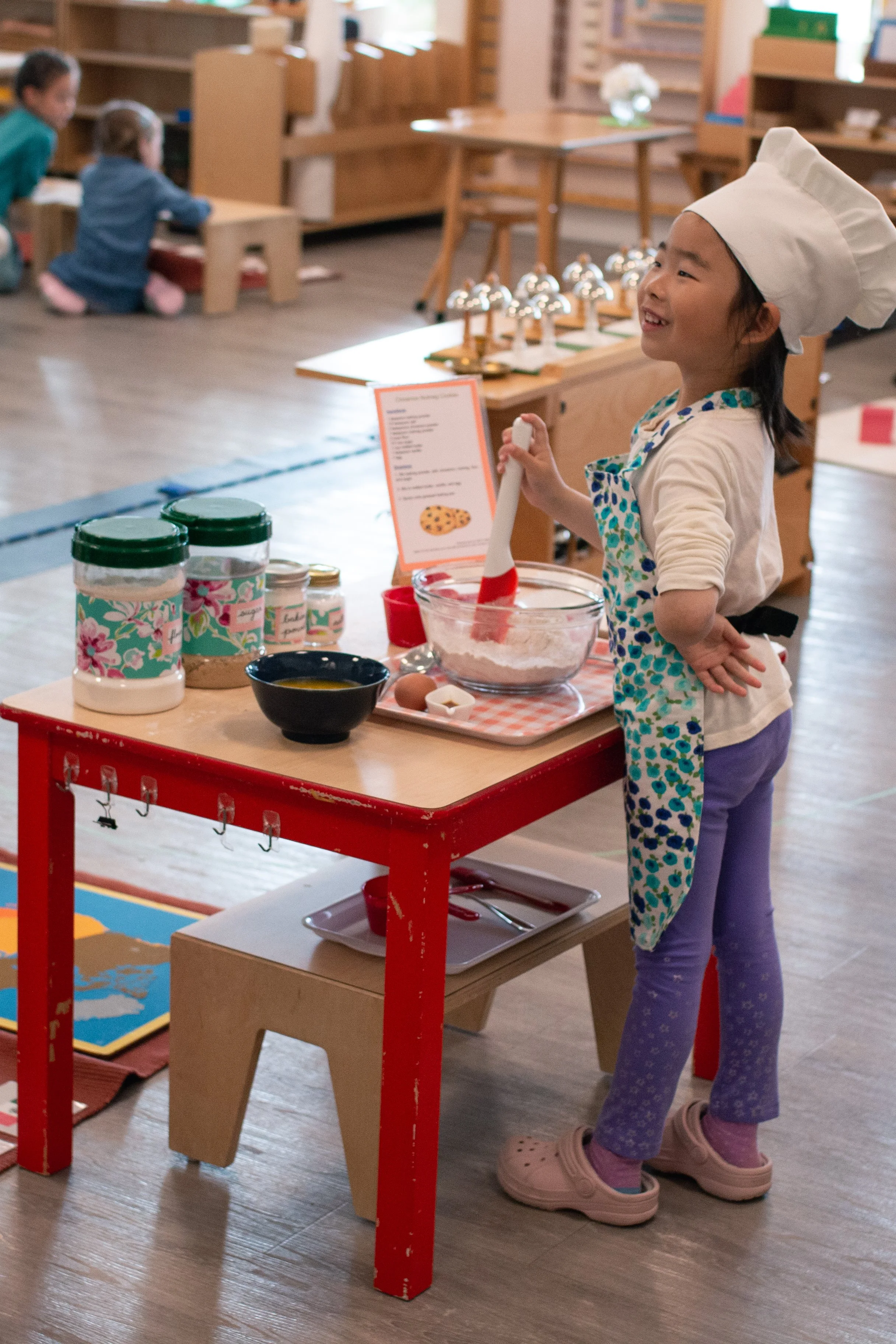
In Montessori, children’s activities are called “work” because they are purposeful, meaningful, and chosen by the child—not busywork or play directed by an adult. This language comes from Maria Montessori, who observed that children naturally seek activities that help them develop concentration, independence, and mastery.
If you’ve ever visited the primary or elementary classrooms at Mia Montessori, you may have noticed something that sounds a little surprising at first: children talk about choosing their work.
Not their activity.
Not their assignment.
Not even their play.
Their work.
For families new to Montessori, this language can feel formal for early childhood education. But in a Montessori environment, the word work is intentional, respectful, and deeply meaningful.
“Play is the work of the child.”
— Dr. Maria Montessori
Honoring the Child’s Effort
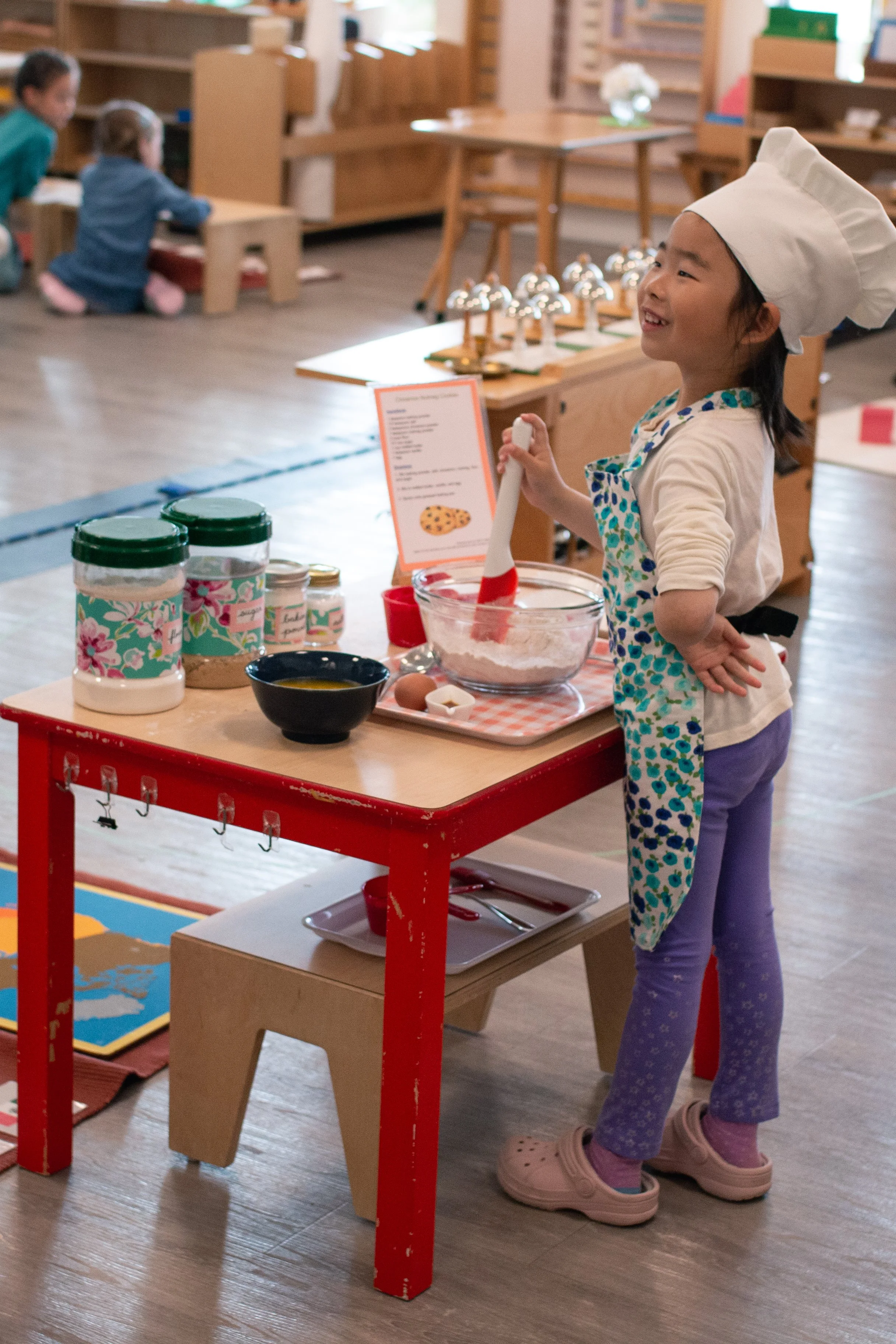
The term comes from the observations of Maria Montessori, who saw that children are not passive learners. They are active builders of themselves. When a child carefully pours water, traces sandpaper letters, builds the Pink Tower, or solves a math problem, they are doing more than playing. They are:
Developing coordination
Refining concentration
Strengthening independence
Building neural pathways for future learning
Calling it work acknowledges the focus and effort children invest in these tasks. It communicates that what they are doing matters, because for the child, play is a serious and purposeful activity.
“ Grown-ups think of play as a purposeless occupation that keeps children happy and out of mischief, but actually when children are left to play by themselves very little of their activity is purposeless. ”
-Dr. Maria Montessori, Maria Montessori Speaks to Parents
Concentration Is the Real Goal
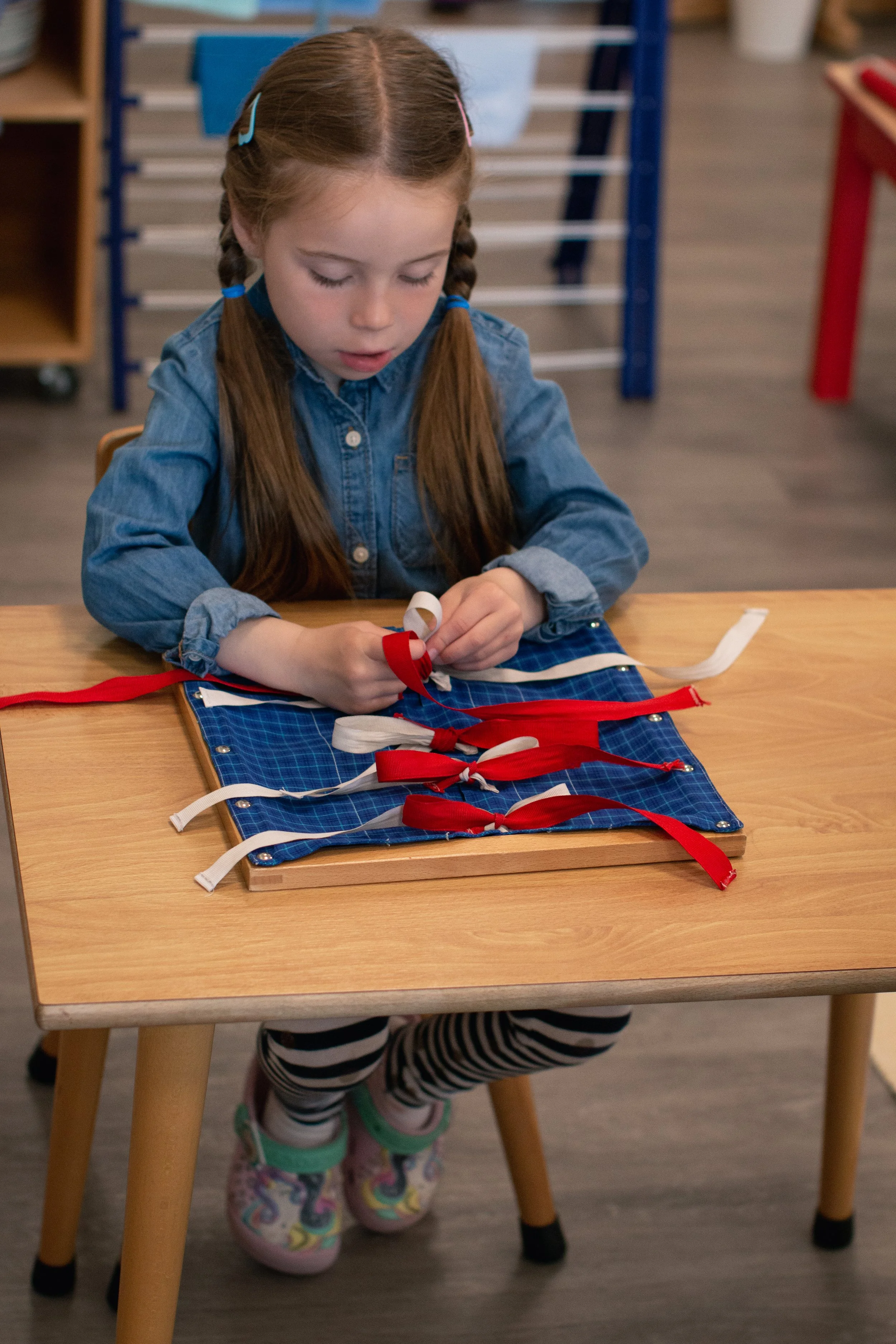
In a Montessori classroom, uninterrupted work cycles allow children to fully immerse themselves in a task. When a child becomes deeply focused—sometimes for 20, 30, or even 60 minutes—they are developing one of the most important foundations for lifelong learning: the ability to concentrate.
This is why we protect long work periods in our programs. You can learn more about how our classrooms are structured on our Programs page.
Independence Builds Confidence
Montessori work is carefully designed so children can complete it independently—from beginning to end.
They choose it.
They carry it.
They complete it.
They return it.
This cycle builds confidence in a powerful way. Instead of relying on constant adult direction, children begin to see themselves as capable problem-solvers.If you’re curious about how independence develops in early childhood, our Montessori philosophy page shares more about our approach.
“A child’s work is based on doing things for their own sake… through their work they are building who they will become.”
— Dr. Maria Montessori, Maria Montessori Speaks to Parents
Work Is Joyful
Importantly, Montessori work is not rigid or pressured. It is joyful, hands-on, and self-directed. When children are free to choose meaningful tasks in a thoughtfully prepared environment, their “work” feels deeply satisfying. You’ll often hear a child say:
“I’m not done with my work yet.”
That sense of ownership is exactly what we hope to nurture.
Preparing for Life — Not Just School
When we use the word work, we are also planting a seed: that learning is purposeful and valuable.
Children who experience meaningful work develop:
Persistence
Responsibility
Intrinsic motivation
Respect for their environment
These qualities extend far beyond the classroom.
At Mia Montessori, we see each day that children are not simply learning letters and numbers—they are engaged in the important work of building themselves. As part of our commitment to partnership and transparency, we warmly invite parents to observe a morning work cycle in the classroom. During these quiet observation mornings, families often witness the calm focus, independence, and intrinsic motivation that define a Montessori environment.
Montessori classrooms call it “work” because children are doing the important work of building themselves—intellectually, socially, and emotionally. It respects the child. In a Montessori classroom, children are doing real, developmentally appropriate tasks—pouring, building, reading, calculating, problem-solving. Calling it “work” honors the effort and focus children invest, just as we would with adults.

The Science of Reading
In an effort to improve literacy, there is a movement across North America focused on The Science of Reading. Although the Science of Reading is a new approach to reading in traditional education, Dr Montessori developed the principles over 150 years ago for application in Montessori early childhood (primary) and elementary environments. The Montessori approach, similar to the Science of Reading, emphasizes building foundational skills through a scientifically researched, structured, multi-sensory approach.
In an effort to improve literacy, there is a movement across North America focused on The Science of Reading. It is an interdisciplinary body of research spanning 50 years spanning several fields including cognitive psychology, neuroscience and linguistics. It has been developed based on empirical evidence, rather than being curriculum focused. The Science of Reading emphasizes the importance of systematically teaching foundational skills like phonemic awareness (the sounds of individual letters), phonics (the relationship between sounds and letters), fluency, vocabulary and comprehension.
Although the Science of Reading is a new approach to reading in traditional education, Dr Montessori developed the principles over 150 years ago for application in Montessori early childhood (primary) and elementary environments. The Montessori approach, similar to the Science of Reading, emphasizes building foundational skills through a scientifically researched, structured, multi-sensory approach.
How does a Montessori guide (teacher) teach a child to read?
Phonemic awareness and phonics
In a Montessori environment, phonemic awareness is developed first with oral language and then writing activities. The sound cylinders, a Sensorial material, help the child build and increase their awareness of the tone and pitch of sounds. The Sandpaper Letters are a tactile material that help the child associate letter sounds with their symbols. The Moveable Alphabet engages the child in a tactile exploration of writing. In a Montessori environment, the child is guided through the process of recognizing that language is made up of sounds, that each sound is represented by a letter and by blending these sounds together they can form words.
Multi-Sensory Learning
A foundational element of Montessori education is the use of multi-sensory materials. The materials engage multiple senses, which helps the child strengthen their understanding of sounds, symbols and word formation. For example, when working with the Sandpaper Letters, a child traces letters formed of sandpaper (tactile and muscular), sees the symbol (visual), and hears and says the sound of the letter (auditory). Similarly, when working with the Moveable Alphabet, the child practices building words with their hands (tactile and muscular) as they see the letter symbols (visual) and say the letter sounds (auditory). This reinforces phonetic language and word structure.
Systemic ad Sequential Instruction
Montessori materials are structured sequentially, from simple to more complex. This allows children to build their knowledge gradually and incrementally, ensuring a sound foundation (pun intended). Children start with basic sounds, progressing to phonograms and puzzle words. The materials teach the children through a variety of methods - encoding (i.e. writing), decoding (i.e. reading) and eventually leading to fluency. This systemic approach is advocated by the Science of Reading.
Vocabulary
In a Montessori environment children are introduced to vocabulary in every area of the curriculum. Children are presented with precise terms, synonyms for words they already know and complex, multi-syllable words that many would think are too advanced for a young child. The Montessori teacher understands there is no limit to the quantity of complex words children can learn, as long as the vocabulary is used in the right context (for example, a child may get ‘injured’, ‘hurt’ or ‘cut’, rather than get an ‘owie’).
Encoding before Decoding
While the Science of Reading method focuses specifically on reading, the Montessori method focuses on all aspects of language skills and culminates in reading. In fact, writing comes before reading in a Montessori classroom. Dr. Montessori understood that writing is easier for the child than reading. Writing is encoding and involves a child putting together sounds they know to build words. Reading is decoding, or taking words apart to identify their sounds and putting them back to understand their meaning. When a child reads, they are presented with a whole word and must take the word apart to identify its sounds and then put it back together to understand its meaning. Only when the child is confident with writing (encoding) does the Montessori method progress to reading (decoding).
The Montessori method was developed over a 100 years ago, based on research, study and experimentation. The Science of Reading has similarly been based on research and experimentation and embraces many of the same Montessori principles for reading. Both methods follow a structured, phonics-based, multi-sensory, and sequential approach. A key difference is that Montessori understands the value in learning to write before beginning to read.